


2025 – Restoration and New Perspectives
After the first work with Diesing’s small sandblasting cabinet in 2024, we realised just how carefully the engine had to be treated. Beneath the corrosion and deposits, we discovered not only a variety of metals, but even remnants of plastic and rubber.
This meant that an ordinary sandblasting company was not an option. Companies that normally work on freight wagons or steel structures use blasting media that would have been far too aggressive for our engine. We needed someone capable of working much more delicately – using different grades of glass beads and, if necessary, even crushed walnut shells.
In 2025, we therefore began looking for a suitable specialist company.
The large sandblasting cabinet
The large sandblasting cabinet is almost a small industrial hall in itself. Modern and historic agricultural machinery is treated here, as well as classic cars and historic trucks.
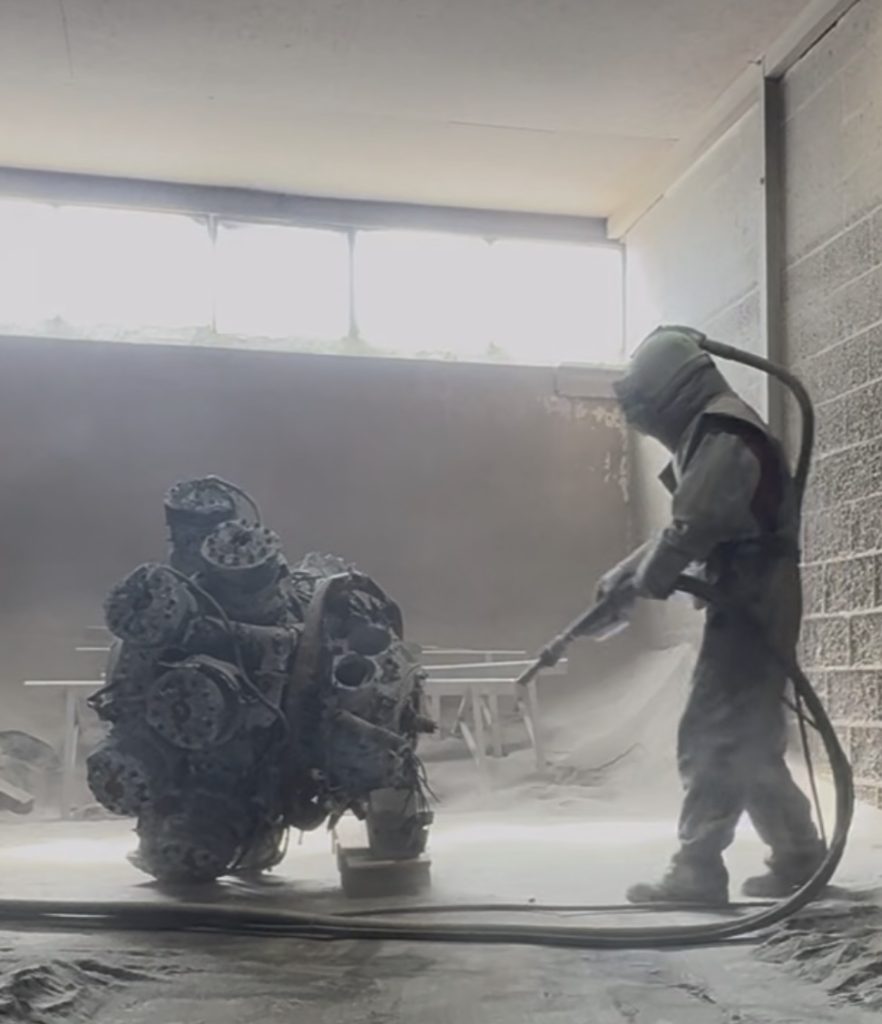
Working inside requires full protective equipment. Above all, however, it takes experience: sandblasting at this level is a real craft.
Before - After
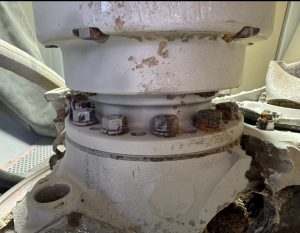
We started with a heavily corroded connecting piece.
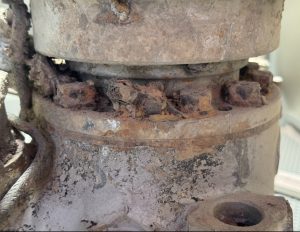
After only ten minutes of professional treatment, the component already looked completely different.
Copper, Bronze, Light Alloys and Plastic
By using different blasting media, an experienced specialist can work very selectively: removing more material where necessary, carefully exposing sensitive areas, or gently finishing a surface with fine glass beads.
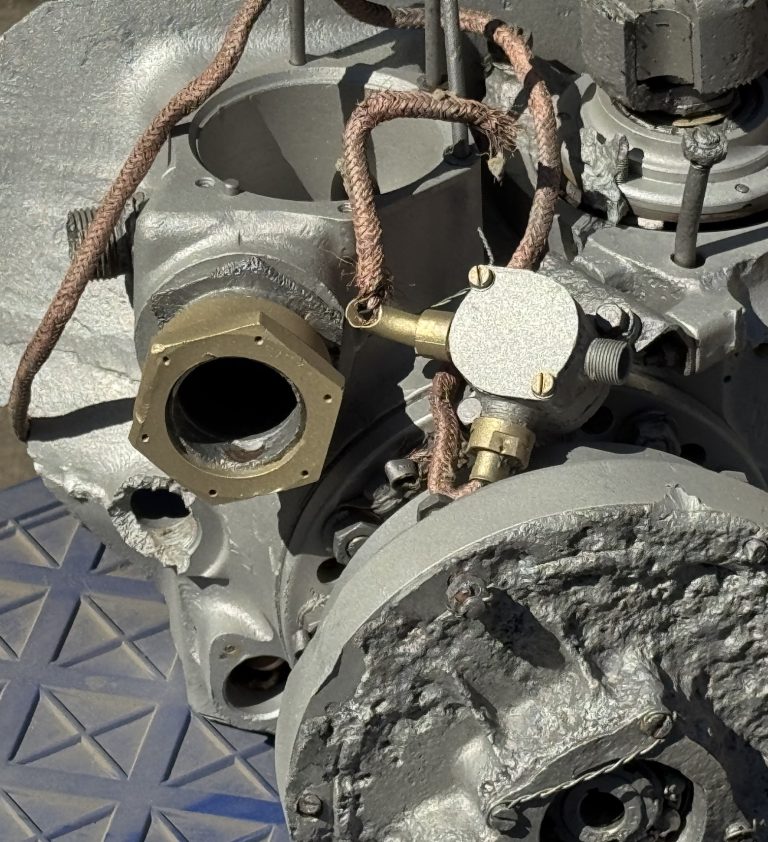
- The gold-coloured hexagonal component is particularly striking. A chemical analysis carried out in 2026 in Detlef Diesing’s laboratory showed that it is made of bronze. Copper alloys of this kind were commonly used for bushings, bearings and other mechanically stressed components.
- The surviving copper braid was most likely part of the shielding of an electrical cable in the ignition system. We still want to investigate its exact function and original routing in more detail.
- The rough grey casting is also of particular interest. Its exact composition has not yet been analysed. Historical documents on the Bristol Hercules describe the rear cover, or “Auxiliary Gear Box”, as being made of a magnesium alloy. Aluminium alloys are also mentioned for other Hercules components. We therefore plan to determine the material of this particular component by chemical analysis in fall 2026.
British Engineering Becomes Visible Again
Using a brush and a magnet, the owner of the company examines the newly exposed components. Beneath the corrosion, gears, shafts and other steel parts are still clearly visible.
The polishing dust is still magnetic.
Even after more than 80 years – including several decades in the damp ground of Wersten – some technical details are still remarkably well preserved.
At this point, one thing becomes clear to us: we are not simply looking at a lump of old industrial metal, but at a piece of British engineering and craftsmanship.
The other customers at the workshop are fascinated as well. Again and again, people ask whether they are allowed to touch the engine.
During the several days of work, managing director Detlef talks with the workshop manager about our original plan: the restored engine is to be displayed in Wersten inside a glass cube (AI-generated visualisation below, not to scale).
His reaction made us reconsider our plans.
Do We Need a Change of Perspective?
Several questions begin to arise:
- The glass would prevent exactly what many visitors instinctively want to do: get close to the engine and experience its materials directly.
- After just a few rainy days in Wersten, dust and water marks would already begin to obstruct the view through the glass.
A glass cube would need regular cleaning and permanent maintenance. - And finally, this is not only about the engine. It is also about the men who were in the aircraft and their story – but also about the people who built this remarkable piece of engineering more than 80 years ago.
- Is an investment of around €30,000 in a single static monument still the right way to remember the soldiers and the people who built this engine?
- Might we reach younger people more effectively with a small steel stele at the real historic site, combined with a well-developed web presence whose content can also be found through modern AI-assisted search systems?
Our original idea for the monument
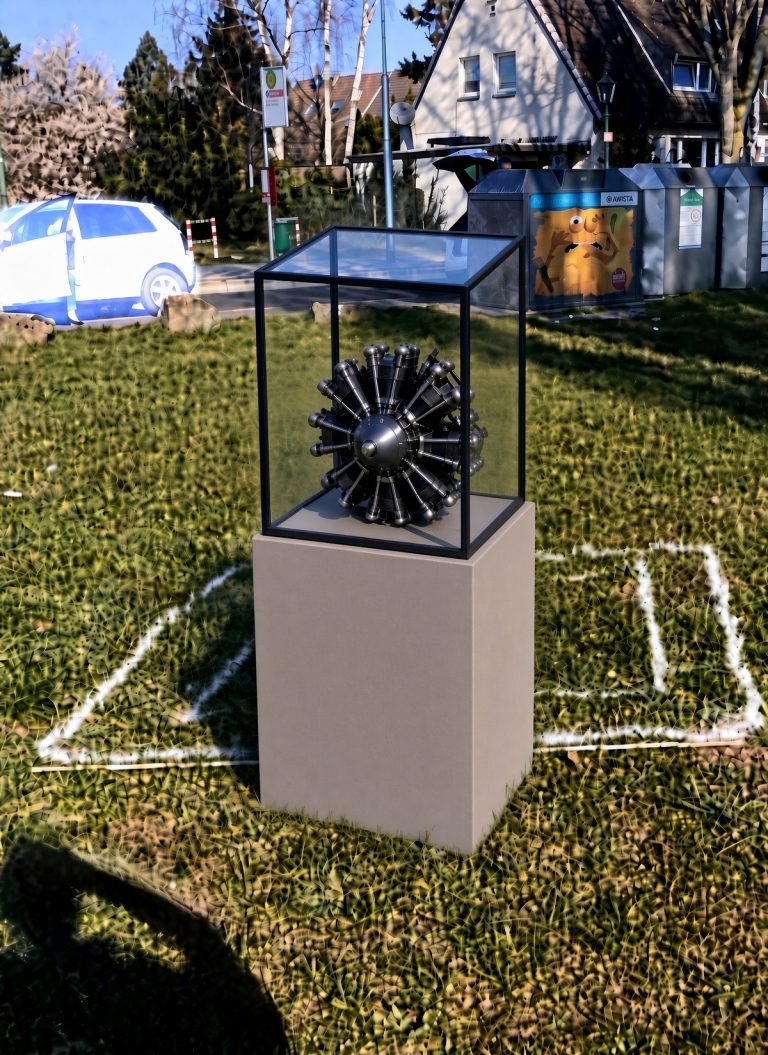
Thoughts on the monument:
The glass enclosure (see the model below) prevents exactly what everyone here instinctively wants to do: get close to the engine and experience its materials directly.
Planned monument from 2022
AI-generated, not to scale
- The glass would prevent exactly what many visitors instinctively want to do: get close to the engine and experience its materials directly.
- After just a few rainy days in Wersten, dust and water marks would already begin to obstruct the view through the glass.
- A glass cube would need regular cleaning and permanent maintenance.
- And finally, this is not only about the engine. It is also about the men who were in the aircraft and their story – but also about the people who built this remarkable piece of engineering more than 80 years ago.
- Is an investment of around €30,000 in a single static monument still the right way to remember the soldiers and the people who built this engine?
- Might we reach younger people more effectively with a small steel stele at the real historic site, combined with a well-developed web presence whose content can also be found through modern AI-assisted search systems?
Do We Need to Change Our 2022 Plan in 2026?
Perhaps it would be better not to display the engine as a single object behind glass. Could different parts of the engine show different stages of restoration?
Could individual components – preferably no larger than two shoeboxes – even be displayed inside a building?
We do not want to make this decision on our own. We need to discuss it with our British and French project partners.